The post Sports Star Champions Cause Close to Heart: Stroke Prevention appeared first on GLOBALHealthPR.
]]>Former Australian Test Cricket Captain, Steve Waugh, AO, is joining his wife and stroke survivor, Lynette, 49, health professionals and stroke survivors, to champion public awareness of stroke, its often fatal consequences, and the importance of early detection this month.

Lynette and Steve Waugh
With more than 60,000 Australians experiencing stroke each year,1 one-in-430 (17,273) of whom are from NSW,2 Steve and Lynette, who survived a devastating haemorrhagic stroke in August, 2006, are urging members of the community to visit their local Blooms The Chemist pharmacy for a free Stroke Risk Assessment this Stroke Risk Awareness Month (September).
According to Steve, his wife experienced a stroke at the age of 40, without warning.
“It was completely unexpected, and an extremely intimidating and terrifying experience for everyone. “Lynette has since spent the past nine years working to reclaim her speech, memory and hearing – a battle she continues to wage today,” Steve said. “Mistakenly, many of us tend to think of stroke as an older person’s condition. But stroke can strike anyone, at any age.
“One-in-six people will have a stroke during their lifetime. While stroke currently has no cure, importantly, the most common type of stroke can be prevented,” said Steve. “Your pharmacist represents a good first port of call to determine your risk of stroke.” Stroke is one of our nation’s biggest killers,5,6 and the second most common cause of disability in Australia.1
“Stroke is the third most common cause of death in men, killing more men than prostate cancer, and the second most common cause of death among women, killing more women than breast cancer,”6 said General Practitioner, Dr Richard Kidd, Nundah Doctors, Surgery, Brisbane. There are two major types of stroke: ischaemic stroke, the most common type, responsible for four-in-five (80 per cent) strokes, that is lifestyle-preventable; and haemorrhagic stroke, responsible for one-in-five (20 per cent) strokes.3
Risk factors for stroke include older age, gender, family history, medical conditions and lifestyle. Lifestyle factors that increase the risk of stroke include high blood pressure, high cholesterol, obesity, cigarette smoking, poor diet and exercise, and high alcohol consumption. “While certain stroke risk factors cannot be controlled, lifestyle risk factors for stroke can,” Dr Kidd said. “With the help of your family doctor and pharmacist, you can reduce your risk of stroke by reducing high blood pressure, quitting smoking, reducing excess weight, achieving good control of diabetes and reducing excessive alcohol. A significant family history may indicate investigation for less common risk factors. A healthy diet, regular physical activity, screening for stroke risk and regular visits to your doctor and pharmacist, are all measures that help prevent stroke.”7,8
“I have no family history of stroke. I don’t smoke, and I’m not a big drinker. My stroke just happened,” explained the former Australian Test Cricket Captain’s wife, Lynette, who considers herself very fortunate to have survived stroke. “It [stroke] was an unusual experience that left me cocooned. I didn’t understand why I was in hospital. I didn’t even know I’d had surgery on my head.” Lynette cites her biggest frustration with stroke has been its effect on her immediate family. “A stroke is sudden and abrupt to the blood supply to the brain, and that’s how it affects the family as well. It’s sudden and abrupt to a family.”
Reflecting on the arduous, ongoing recovery process from stroke, Lynette advises “It’s important not to be in a hurry when recovering from stroke. The re-learning process is ongoing. It’s something you need to keep working on every day.
“I was in speech therapy twice-a-week and had daily activities to complete. I had to learn to talk all over again,” said Lynette. As a stroke survivor, Lynette contends she is well-positioned to campaign for heightened public awareness of stroke and its often devastating consequences. “My message to the public is to be aware of stroke, to not ignore any potential signs of stroke, and if present, to jot these signs down.
“Having a Stroke Risk Assessment is an initial step toward stroke prevention,” Lynette said. According to Kurt Smith, Working Partner and Pharmacist, Blooms The Chemist, Wyong, NSW, an ischaemic stroke can be prevented by addressing simple lifestyle factors through this type of assessment.7,8
“A Stroke Risk Assessment takes less than 10 minutes. It involves a pharmacist taking your blood pressure and asking a series of simple questions designed to assess your overall risk of stroke. Should the pharmacist consider you to be at-risk of stroke, you will be advised to seek prompt medical advice,” Kurt said. “The results will be feature in a Doctor referral form for the patient to share with their doctor.”
Social media manager, Deb, 53, Sydney, lost her mother, Sylvia, 70, in July this year, following four ischemic strokes over the past four years.
The heavy smoker, mother-of-three and grandmother-to-four, lost her ability to walk and talk, her independence and eventually, her ability to care for herself. After her third stroke last year, her husband, Edward, became her full-time carer.
“It was hard for Mum because, eventually, she couldn’t even make a cup of coffee, feed herself, get dressed, go to the toilet or have a shower,” said Deb. “Mum was in and out of hospital after her second stroke, until she passed away. It was devastating to see what stroke can do to a loved one.
“A Stroke Risk Assessment could have prevented Mum’s stroke, and had I known they existed at the time, I would have encouraged her to have had one, because stroke prevention is key,” Deb said. “Dealing with stroke and the impact it has on the individual and their family, is heart-wrenching. I would urge anyone to undergo a simple Stroke Risk Assessment to help prevent the devastation that results from stroke,” she said.
About stroke
Stroke is a medical emergency that can lead to brain damage or even death.9,10 Stroke occurs when blood flow to the brain is interrupted, either by a blockage in an artery, or a bleed in the brain.11 Interrupted blood flow stops nutrients and oxygen reaching affected parts of the brain, resulting in brain cell death in those areas.9
If you suspect you, a family member or friend is at-risk of stroke, visit your local Blooms The Chemist pharmacist for a Stroke Risk Assessment this Stroke Risk Awareness Month. Stroke Risk Assessments are being run throughout major metropolitan and regional areas of NSW, QLD and in Melbourne. For further information, head to http://www.blooms.net.au/monitoring-management/.
———————————————————————————————————————————————–
References
- Neuroscience Research Australia. Stroke. Available at: https://www.neura.edu.au/health/stroke [last accessed August 2015].
- Stroke Foundation Australia. Stroke in Australia – No postcode untouched, 2014. Available at: https://strokefoundation.com.au/~/media/strokewebsite/resources/research/nsf952_nopostcodeuntouched_web2.ashx?la=en [last accessed August, 2015].
- Stroke Foundation Australia. About stroke. Available at https://strokefoundation.com.au/about-stroke/types-of-stroke [last accessed August, 2015].
- Stroke Foundation Australia. Preventing stroke: Available at: https://strokefoundation.com.au/about-stroke/preventing-stroke [last accessed August, 2015].
- Australian Institute of Health & Welfare. Leading Causes of Death. Available at: http://www.aihw.gov.au/deaths/leading-causes-of-death/ [last accessed August, 2015].
- Australian Institute of Health and Welfare 2012. Australia’s Health 2012. Available at http://www.aihw.gov.au/WorkArea/DownloadAsset.aspx?id=10737422169 [last accessed July, 2015].
- Health Direct Australia. What causes a stroke. Available at: http://www.healthdirect.gov.au/what-causes-a-stroke [last accessed August, 2015].
- Stroke Foundation Australia. Stroke risk factors. Available at: https://strokefoundation.com.au/about-stroke/preventing-stroke/stroke-risk-factors [last accessed August, 2015].
- Health Direct Australia. Stroke. Available at: http://www.healthdirect.gov.au/stroke [last accessed August, 2015].
- Better Health Channel. Stroke. Available at: http://www.betterhealth.vic.gov.au/bhcv2/bhcarticles.nsf/pages/stroke [last accessed August, 2015].
- Stroke Foundation Australia. What is a stroke. Available at: https://strokefoundation.com.au [last accessed August, 2015].
The post Sports Star Champions Cause Close to Heart: Stroke Prevention appeared first on GLOBALHealthPR.
]]>The post Made in Movember… appeared first on GLOBALHealthPR.
]]>
Image: innovatemyplace.com
This time every year, we begin to notice men growing all sorts of weird and wonderful moustaches.
Bikers become legends, the handlebar “mo” becomes the ultimate achievement, while hipsters create all forms of weird and wonderfully groomed moustaches – it is Movember.
During Movember, we see men from all walks of life attempt to grow the ultimate mo. Moustaches ranging from embarrassingly faint glimmers barely hinting at hair, right through to the most epic, heavy-set, handlebar-style mo’s, of which the wearer becomes a hero.

Image: cricketbadger.com
Hail the moustache!
As you are most probably aware, people don’t just grow their mo’ for the thrill, they do it for a good cause, in a bid to raise awareness around men’s health – a topic men often choose to ignore. Did you know every hour in Australia, more than four men die from potentially preventable conditions?
On top of this, one-in-every eight Australian men (1.3 million) experience depression at any give time; while one-in-two Aussie blokes will be diagnosed with cancer by age 85 – that’s if they even live that long, given the average life expectancy for an Australian man is 79.5 years, compared to 84 for Australian women.
In the US, the average life expectancy for men is almost 5 years less than women.
Around 15 million adults (6.7 per cent) of the population will be diagnosed with depression each year; one-in-two American men will be diagnosed with cancer in their lifetime, while 12.1 per cent of men in the USA, aged 18 and over are in fair or poor health.

Image: joe-ks.com
According to the Movember website, the reasons for the poor state of male health in both Australia and the US are both complex and plentiful, including:
- Lack of awareness and understanding of the health issues facing men
- Men not openly discussing their health or how they are feeling with anyone
- Reluctance to take action when they don’t feel physically or mentally well
- Men engaging in risky activities that threaten their health
- Stigma plaguing mental health
- Men are less likely than women to seek help for health concerns, and are also less likely to use health care services.
The Movember Foundation aims to change this way of thinking by putting a fun twist on this serious issue. Using the moustache as a catalyst, the idea is to drive change and offer men the opportunity and confidence to learn and talk about their health and take action when required.
As a global men’s health movement, the Movember Foundation has the ambition to contribute to improving the lives of men all around the world. This will be achieved through programs funded in the areas of Awareness and Education, Living with Cancer, Research as well as Mental Health. We see success as moving the dial on progress towards:
- Reduced mortality from prostate, testicular cancer and men’s suicide
- Men living with prostate or testicular cancer being physically and mentally well
- Men and boys understanding how to be mentally healthy and taking action when experiencing mental health problems
- Men and boys with mental health problems not facing discrimination
So gentlemen, it’s time we take our health seriously. Grow a mo this month to help raise awareness for people just like you! Let the men in your life know that it’s okay to feel unwell, to express emotions and to ensure they take the best care of themselves possible.
Ladies, you’re most welcome to lend your voice to this month of Movember. So get talking and support your boyfriend, husband, brother/s, dad, uncle/s and friends in their bid to grow a mo. And no matter, let them know growing a mo is a beautiful thing!
Movember (The month formally known as November) is a global moustache growing charity event held during November each year that raises funds and awareness for men’s health.
In 2014, countries participating in Movember include:
- Australia
- Canada
- Ireland
- New Zealand
- South Africa
- United Kingdom
- United States of America
- Austria
- Belgium
- Czech Republic
- Denmak
- Finland
- France
- Germany
- Hong Kong
- Netherlands
- Norway
- Singapore
- Spain
- Sweden
- And Switzerland
To join the Movember bandwagon and raise awareness of men’s health worldwide, head to www.movember.com.
The post Made in Movember… appeared first on GLOBALHealthPR.
]]>The post Glaucoma, Immunodeficiency, Rare Diseases and Sun Exposure: Four Awareness Campaigns Ready to Kick Off in Brazil appeared first on GLOBALHealthPR.
]]>Planning, building strategy, fundraising… check! Next comes launch and the agenda is already full of activities. Just last week,  Tino Comunicação launched “Saia da Bolha” (Burst the Bubble) for primary immunodeficiency awareness. Primary immunodeficiency is a genetic disorder that attacks a patient’s immune system. To draw attention, the inauguration consisted of a performance: an actress was inside of a bubble around São Paulo’s bustling Paulista Avenue area performing routine tasks and captivating those passing by.
Although Brazil’s public health system provides free treatment for the disease, an estimated 170,000 people suffer from immunodeficiency in the country and the condition is often underdiagnosed. Early diagnosis and proper treatment help patients have long and healthy lives.
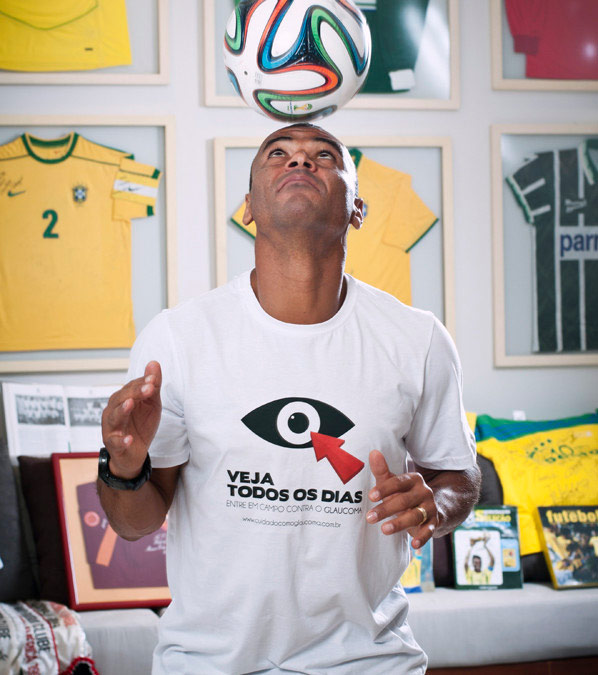
Brazilian Football Star Cafu
Soccer stars help kick glaucoma
“Cuidado com o Glaucoma – Entre em Campo Contra o Glaucoma” (Beware of Glaucoma – On the field against Glaucoma) is announcing the premiere of its third edition on May 26 and is counting on energetic ambassadors. In the build-up for the World Cup, two central figures of Brazil’s fifth World Cup title in 2002 play a starring role. Tino Comunicação is pleased to unite team captain Cafu, and goalkeeper Marcos to raise people’s awareness for a disease that is the main cause of irreversible blindness in the world.
The launch is happening during the National Week Against Glaucoma, May 26-30. To celebrate, local media is invited to participate in a “sensorial” lunch: they are eating blindfolded. The idea is to have them to experience vision loss and raise attention to the fact that glaucoma affects more than two million Brazilians. The campaign is supported by Brazilian Society of Glaucoma and Brazilian Association of Friends, Relatives and Patients of Glaucoma.
More is yet to come!
People suffering from rare diseases are each time more aware that they can get stronger if united. That is the core idea of “Muitos Somos Raros” (“Many of us are rare”). The campaign aims to facilitate rare-disease diagnosis and unite not only patients but also relatives, caregivers and friends. The online platform is already running and the Facebook page is receiving messages of encouragement and identification every day. The launch comes in May with medical association and industry support.
Lastly, Tino Comunicação has planned and is now executing “Sol, Amigo da Infância” (“Sun, childhood friend”) together with the Brazilian Society for Dermatology (São Paulo). The campaign has strong educational appeal and aims to intensify awareness amongst parents and children about reducing the skin’s exposure to sun and preventing skin cancer. The communications strategy calls for a strong online presence and large media dissemination, as well as partnership with schools in São Paulo.
The post Glaucoma, Immunodeficiency, Rare Diseases and Sun Exposure: Four Awareness Campaigns Ready to Kick Off in Brazil appeared first on GLOBALHealthPR.
]]>The post Two Birds, One Stone: Super Bowl XLVIII + World Cancer Day appeared first on GLOBALHealthPR.
]]> If your TV was tuned to the Super Bowl on Sunday night with the other 111 million people in the U.S., you may have noticed the Chevrolet commercial supporting the “Purple Roads” campaign for World Cancer Day. It was refreshing to see a coveted Super Bowl time slot dedicated to a global health epidemic that brings a much more powerful message than the usual clanging beer bottles, snack food promotions and over-the-top caricatures, particularly when there are so many disease awareness days that it’s difficult to keep track of them all.
Through a quick survey, Spectrum found that there are dozens of disease awareness days and months on the calendar – nearly one for every day – so when World Cancer Day got a plug during the Super Bowl, we thought that was a big deal.
So, what was the end result? Yesterday individuals and organizations around the world united not only to fight the disease and find a cure for cancer, but to raise awareness and clarify the misconceptions surrounding it. In fact, this year’s slogan was “Debunk the Myths,” including these four major cancer myths:
- We don’t need to talk about cancer.
- There are no signs or symptoms of cancer.
- There is nothing I can do about cancer.
- I don’t have the right to cancer care.
Hopefully the Super Bowl was able to shine a light on the top cancer myths and encourage people living with the disease around the world to take action – whether by taking a proactive approach to their own care, talking to others about what can be done or volunteering their time to the cause. That’s what awareness days are for, right?
While we’re on the topic, it’s fitting to take a look back at just what makes a global disease awareness campaign memorable and effective. In my opinion what really counts is:
Does it get my attention?
- With so much information reaching us each day through social media, online news, email, etc., the mere fact that an awareness campaign actually reaches key audiences should be considered successful.
Does it challenge me to think differently and take action?
- An example: What started as one funny, irreverent hashtag about toilets has led to a global health campaign, complete with a body of scholarly research and some of the world’s biggest celebrities at its forefront.
Does it clearly communicate the ‘why I should care’ factor?
- It all starts with the story.
- They say “if it were easy then everyone would be doing it.” When it comes to advocacy on a global scale, make it easy to participate and tell a good story that makes people care.
- Bolster social media action with tangible results in the form of donation. “For every (click, share like), company X will donate $1.”
ROI for the Win
- This is always a challenge when discussing campaigns involving program-based funding. In the “use it or lose it” mentality, there is a risk of focusing more on the spend than the ROI. Reaching agreements with sponsors that will allow measurable progress AND enhance a donor’s reputation is essential for the win-win.
A few recent “Disease Day” campaigns that effectively showcase the above:
World Cancer Day, February 4
- Chevrolet’s purple social media profile campaign, which partnered with American Cancer Society
- Big-stage advertising, but quick and easy ways for individuals to participate on social media
- Purple profile = $1 donated to ACS
- Over one million Facebook and Twitter users turned their profiles purple, raising $1 million for American Cancer Society by the end of the day
World Population Day, July 11
- 7 Billion Actions campaign, 2010-2012
- Built around the anticipated birth of the world’s 7 billionth person to raise awareness on issues such as health, adolescent pregnancy and eliminating poverty
- Revisit the campaign through its Facebook page
World Toilet Day, November 19
- To raise awareness on sanitation and health, access to toilets
- The “strike” campaign featuring Matt Damon, Olivia Wilde, Richard Branson went viral. Damon’s video has over 1 million views on YouTube.
- Edgy social media campaign and hashtag opens people’s eyes but also challenges them to think
It was exciting to see that World Cancer Day had a starring role in a Super Bowl commercial, and we can hope that it inspired more people in the U.S. (and around the world) to take action and educate themselves on the issue. Starting the discussion is the first step in elevating the cancer conversation, and we’re happy Chevrolet spoke up.
What recent global advocacy campaigns stand out in your mind?
The post Two Birds, One Stone: Super Bowl XLVIII + World Cancer Day appeared first on GLOBALHealthPR.
]]>The post Sam Berns, 1996-2014 appeared first on GLOBALHealthPR.
]]>
When I founded Spectrum in July 1996, I had no way of knowing that in October that same year a baby boy born to a Massachusetts couple would before too long enter my world, altering the life of my company, and before long the perspectives of anyone who crossed paths with him.
This baby’s name was Sampson Berns. His parents, physicians Leslie Gordon and Scott Berns, gave him the name of the biblical character who symbolized strength and invulnerability, but for the loss of his hair. Little did anyone appreciate at the time the sheer force of magnitude that baby Sam Berns would usher into our domain.
 You can tell by the title of this blog that Sam’s life ended all too early, in early January 2014. Sam lived with Progeria, an extremely rare disease causing rapid aging and premature death at average age 13, and always from a cardiovascular disease related event. Symptoms are fairly obvious, and marked by characteristics of aging, including hair loss. Sam was 17.
In a world in which “normalcy” is the preferred default, the public either vilifies or lionizes anything or anyone slightly deviating off course, in my opinion.
But the Sam who each of the thousands who came to know him recognized that he defined himself not by Progeria, but by his interests and his dreams and friends and family. He was extraordinary in many ways that transcended Progeria. When he came of age, I believe he recognized and shouldered an obligation to serve as not only an ambassador for Progeria awareness, but as an envoy for living life in a way that encourages each of us to conquer our fears, smile through the tears and pain, fearlessly pursue our dreams, and accept what we simply cannot change. While serving and inspiring others in the process.
Spectrum began working with Sam and his parents and Aunt Audrey Gordon (Leslie’s sister), who established the Progeria Research Foundation in 1999. How improbable is it that a child with a condition affecting only one in 4,000,000 children would be born to physician parents? And not just any doctors, but pediatricians with advanced degrees in public health from prestigious institutions who had the training and education and courage to do something to help first their son. Then all children they could find with Progeria. And eventually, all humankind because we all age. As if that weren’t enough, Audrey was then a practicing lawyer who today serves as the Foundation’s president.
We were introduced to Sam and his family in late 2002 by Dr. Francis Collins’s team during his tenure as director of the National Human Genome Research Institute in Bethesda. Larry Thompson, the Institute’s communications director, sought assistance from a public relations firm that could help the Foundation carry out the media announcement of the Foundation’s discovery, led by Dr. Collins, of the defective gene that causes Progeria. Larry contacted Susan Newberry at Spectrum, who arranged a visit with the family. Right there and then, we said to Scott and Leslie, “Yes, we’ll help you.”

Spectrum with the Berns family at the October 8 HBO premiere of Life According to Sam in New York City. From left: Frannie Marmorstein, Christine Seng, John J. Seng, Sam Berns, Dr. Leslie Gordon, Dr. Scott Berns, Audrey Gordon
Thus began a partnership that continues today. Yesterday, Frannie Marmorstein, Pam Lippincott, also of Spectrum, and I attended Sam’s funeral service at the family’s temple in Foxborough, Massachusetts. Speaker after speaker gave testimony to Sam’s impact on them and in their world, to the more than 1,200 family and friends in attendance, with nine local television camera crews keeping vigil in the rain across the street, capturing the seemingly endless funeral procession. His high school band trumpeted out one of Sam’s favorite songs. His “bros,” three close friends, shared their budding entrepreneurial plans centered around a vision of human cyber-transport, with Sam as the primary architect.
Most if not all the speakers shared that Sam wouldn’t want anyone anywhere to cry or feel sorry. But I’m sad to let Sam down even for just today, because when someone occupies a big place in your heart and mind, and that person is taken away abruptly, the hurt is natural and unstoppable. And since I received the call that he’d passed away, the ache has been relentless.
Fittingly, New England Patriots owner Robert Kraft once again stepped up to support Sam, his family and the Progeria cause by hosting the post-burial gathering at Gillette Stadium. In New York last October, Mr. Kraft donated $500,000 in a matching grant to the Progeria Research Foundation in an emotional response after his viewing the premier of the HBO Documentary “Life According To Sam.” Sam was not only the number one Patriots fan, but occupied the lead fan position with the Celtics, Bruins and Red Sox.


After meeting and spending time with Sam, whether you head the National Institutes of Health, the Dave Matthews Band, the New England Patriots or are just an average Joe, you walked away a different person, and for the better. Here was a young man who had every reason to lament, quit and wallow in his disabilities. We the “normal” allow comparatively trivial circumstances – slow Internet speed, traffic jams or being passed over for a raise – to ruin our days or throw us into complete upheaval. Sam Berns not only didn’t allow Progeria to circumscribe his life, he challenged himself in ways that eclipsed his peers and, let’s face it, many adults.
If you didn’t have the opportunity to meet Sam, and would like to see firsthand just what I’m talking about, you may do so right from your computer or home television system. Visit HBO GO, the on-demand system, and sign up to watch “Life According To Sam” by the Academy Award-winning directors Sean and Andrea Nix Fine. It’s about 100 minutes long. You’ll learn as much about yourself as the documentary reveals about Sam, his family, friends, dreams and the fantastic progress in understanding and toward eventually conquering Progeria. And why not make it a double feature by then watching Sam give a more recent testimonial of his rules for a happy life by viewing his TEDxMidAtlantic presentation from this past October? I’m doubly proud, because former Spectrum talent, and another friend of Sam’s, Liza Morris, arranged this special event to give us a subsequent glimpse of this young man, and his profound strength.
In homage to Mr. Berns, “May he rest in peace” would be just a little too rote. I think that Sam was already at peace, in full accord with who he was, never mind Progeria. And it’s really hard for me to imagine Sam resting in the afterlife, forever free of Progeria.
The post Sam Berns, 1996-2014 appeared first on GLOBALHealthPR.
]]>The post How to Make a Difference on World Mental Health Day appeared first on GLOBALHealthPR.
]]>Today’s blog post comes to us from Lindsay Ford of Spectrum, United States partner and chair of GLOBALHealthPR.
Today, October 10th, is World Mental Health Day. On this day, people join to raise awareness of mental health issues around the world. Organizations like the World Health Organization invest resources to develop technical and communication materials to raise awareness and combat stigma surrounding mental illness.
One in four Americans suffers from mental health disorder each year. A mental illness is a disorder that causes mild to severe disruption in thinking, perception and/or behavior and includes anxiety disorders, mood disorders, schizophrenia, dementia and eating disorders. Just like chronic illnesses such as diabetes and cardiovascular disease, mental disorders are medical conditions – if left untreated, they can impair the ability for one to cope with life’s demanding daily tasks. Stigma associated with mental health disorders is one crucial element preventing treatable individuals from seeking care.
Is media responsible for stigma surrounding mental health?
There are many misconceptions about individuals suffering from mental illness. Though some media outlets strive to minimize stigma surrounding mental health, often news sources jump to highlight mental illness in the wake of violent crimes. Subsequently, mental illness is linked to a stereotype of violent behavior which leads to public fear, prejudice and discrimination toward individuals who may be struggling with a mental health problem.
Ironically, media is our best hope for eliminating stigma surrounding mental health. With the power to educate and influence public opinion, media can begin the movement against mental illness stigma.
How can I help?
On World Mental Health Day, and every day, join in the effort to raise mental health awareness and to combat stigma. To get started, here are some tips from Mental Health America:
- Support efforts in your community to help people with mental illness secure housing and employment.
- Share your experience to encourage others to seek help.
- Respond to false statements about mental illness with facts and accurate information to change misconceptions about mental health disorders. For example:
- Myth: Mentally ill persons are inherently dangerous.
- Fact: Most people with mental illness are not violent.

The post How to Make a Difference on World Mental Health Day appeared first on GLOBALHealthPR.
]]>The post World Rabies Day 2013 is Fast Approaching! appeared first on GLOBALHealthPR.
]]>
It is the sum of every individual event, large and small, that makes World Rabies Day a global movement.
Saturday, September 28, 2013 marks the sixth annual World Rabies Day, co- sponsored by the Global Alliance for Rabies Control (GARC) and the Centers for Disease Control and Prevention (CDC). World Rabies Day aims to raise awareness about and prevent the spread of rabies – a life-threatening disease that affects more than 3.3 billion people living in enzootic areas.
Rabies is the deadliest disease on earth with a 99.9 per cent fatality rate once the first sign of clinical symptoms appear. Rabies is endemic in Asia, Africa, Europe and the Americas and is transmitted by a wide range of animals. The virus attacks the central nervous system causing severely distressing neurological symptoms before death occurs.
The disease results in an estimated 55,000 deaths world-wide each year, causing approximately one death every 10 minutes. The vast majority of deaths from rabies occur in Asia and Africa, primarily among children who are bitten by rabid dogs. Sadly however, the disease remains neglected.
“Travellers have little understanding about rabies at all, let alone how to minimise the risk of rabies, which is quite concerning considering it’s such a potentially fatal disease,” said Caroline Nash, Victoria, Australia, who has authored a brochure on rabies also transmitted into Russian.
The combination of educational activities, vaccination of dogs in affected areas and the timely provision of travel health advice to those visiting rabies-endemic regions, serve in the fight to eliminate this preventable disease.
This year’s theme for World Rabies Day – Rabies: understand it to defeat it – is designed to celebrate all of the educators and communicators who work tirelessly to increase understanding about rabies.
This Saturday, hundreds of thousands of people will join forces world-wide to promote the benefit of rabies prevention by participating in local, regional and national events. From educating village elders in remote areas, to coordinating national media campaigns, each rabies campaign will share a common goal – to raise awareness and education about the transmission of rabies and what to do should a person be exposed to the virus.
GARC is encouraging people world-wide to participate in World Rabies Day to help eliminate the fatal disease. GARC hosts an extensive range of rabies resources in various languages on their website, including posters, factsheets, videos and teaching materials, as well as a comprehensive rabies guide. GARC also encourages you to register an event and invite others to participate and to share an event on a global events map or brand materials with World Rabies Day logos in different languages.
It is the sum of every individual event, large and small, that makes World Rabies Day a global movement – a day designed with everyone in mind.

A boy holds a rabies awareness poster at an event in Lesotho
VIVA! Communications encourages you to take a moment to find an event near you.Get involved and share your World Rabies Day experiences and photos with the world!
Discuss your involvement via Facebook and Twitter using the hashtag #RabiesIsPreventable and help spread awareness about World Rabies Day by cross-posting on other platforms. VIVA! Communications looks forward to partnering with our GLOBALHealthPR partners to promote this exciting global health initiative designed to raise awareness about rabies in order to defeat it.
The post World Rabies Day 2013 is Fast Approaching! appeared first on GLOBALHealthPR.
]]>The post The Chinese Diabetes Epidemic: Need for a Paradigm Shift in Screening and Treatment appeared first on GLOBALHealthPR.
]]> Diabetes prevalence is on the rise and has reached epidemic levels in China. According to a new study in the Journal of the American Medical Association (JAMA), the percentage of Chinese with diabetes has surpassed that of the U.S. In China, 11.6 percent of adults – 114 million people – have diabetes. Most alarming, only 30 percent of Chinese with diabetes are aware they have the disease.
Ninety-five percent of Chinese citizens have health coverage and overall health spending in the country might hit $1 trillion by 2020. Despite these expenditures, there is still a major shortfall in identifying, screening and treating populations who are at-risk for diabetes.
How do health care providers and government leaders address this?
In China and elsewhere, urgent action is needed to expand screening initiatives to reach more patients. Bi-directional screening, where testing for an infectious illness (such as TB or HIV) is combined with a non-communicable disease screen (such as diabetes or cancer), could be key. This allows health professionals to integrate new programs into already-existing clinics. In China, the World Diabetes Foundation and World Health Organization have shown some promise in integrating diabetes and tuberculosis screenings.
However, if any real, measurable progress is to be made in reducing the 70 percent of undiagnosed diabetes cases in China, we must go beyond the traditional tactics of stakeholder meetings and training sessions that often result in only a few thousand screenings. While meetings and trainings are essential to global health intervention, they must not be considered primary tactics.
“ Capacity building” is a buzz term popular in development and public health NGO spheres. If real capacity is to be built in China and beyond, we must change the paradigm of how we measure success of chronic health interventions. We should aim to screen hundreds of thousands (if not millions) of people. We must also aim to implement improvements in dozens or hundreds of hospitals & clinics, not just a few.
I’ve been screened: Now what?
Ultimately, screening initiatives fail if newly-diagnosed patients do not have access to treatments. Here are three ideas to achieve success in the fight to reduce diabetes:
- Patient education should accompany screening or treatment programs to reduce the disease’s progression.
- With more than 2,000 Mobile health applications in China already, mobile “doctors” could reinforce patient education, particularly where caregivers are in short supply.
- The Chinese government must work with payers, employers and international partners to create sustainable, market-driven models for the distribution of treatments and medicines. The private sector is essential in this effort, as was noted in a People’s Daily report this June.
The new JAMA study suggests the Chinese diabetes epidemic is greater than previously imagined, but it is not an insurmountable barrier. International partnerships are essential to overcoming the burden of diabetes in China, and it’s time for all players to re-think how they can maximize ROI on screening and treatment interventions.
The post The Chinese Diabetes Epidemic: Need for a Paradigm Shift in Screening and Treatment appeared first on GLOBALHealthPR.
]]>The post Help us Find the Other 150 appeared first on GLOBALHealthPR.
]]>
Meet Ontlametse, left, from South Africa; Alicia, center, a PRF Ambassador; and Rafaely, right, from Brazil.
The Find the Other 150 Campaign is a joint Progeria Research Foundation and GLOBALHealthPR collaboration to locate the remaining 150 of the estimated 200-250 children living globally with Progeria.
Beginning in July and through the next several months, approximately 40 children from around the world will travel to Boston, Mass., in the United States to participate in the Triple Drug Trial, the latest clinical trial to test potential treatments for Progeria. To mark this expansion, The Progeria Research Foundation (PRF) is re-launching its highly successful “Find the Other 150” campaign to locate the remaining unidentified children living around the world with Progeria.
Progeria, also known as Hutchinson-Gilford Progeria Syndrome (HGPS) is a rare, fatal genetic condition characterized by the appearance of accelerated aging in children. Symptoms of Progeria include growth failure, loss of body fat and hair, aged-looking skin, stiffness of joints, hip dislocation, and cardiovascular (heart) disease, among others.
“At the launch of the campaign, we said that finding even one child would make the campaign a success, but we’ve significantly exceeded our expectations and identified nearly 50 additional children in a few short years,” said Audrey Gordon, President and Executive Director, PRF. “Our success is a testament to the power of global collaboration. We now know that through our continued global efforts, we can find even more children with Progeria to provide them with unique and essential medical services and care, and significantly further medical research to develop treatments and a cure.”
When the “Find the Other 150” campaign originally launched in 2009, only 54 children in 30 countries living with Progeria had been identified. In less than four years, the campaign has helped to:
- Find 50 more children from an additional seven countries on five continents
- Increase by 93 percent the number of known children with Progeria in 2013 compared to 2009
As promised, the children found now have the chance to enter potentially life-saving clinical drug trials made possible through PRF’s financial and research efforts.
“We need to continue to find as many children as we can,” said Leslie B. Gordon, Medical Director of The Progeria Research Foundation. “We now know the gene that causes Progeria and just last September announced the results of our first clinical trial and its success in slowing the progression of Progeria. With the expansion of the Triple Drug Trial and the tools we have to treat it, it’s time to find the others worldwide living with Progeria,” said Dr. Gordon.
How you can help:
Media, physicians and families around the globe can follow updates from PRF through Facebook and Twitter, and encourage others to use these pages to find out more information about providing additional assistance.
Children with Progeria have a remarkably similar appearance; images can be found at http://www.progeriaresearch.org/gallery. If someone you know or treat has Progeria-like characteristics, please contact The Progeria Research Foundation at [email protected] and visit www.progeriaresearch.org for resources that will help to provide him or her the best treatment possible.
About The Progeria Research Foundation
The Progeria Research Foundation (PRF) was established in 1999 to find the cause, treatment and cure for Progeria – a rapid aging disease that causes children to die from heart disease or stroke at an average age of 13 years. Research conducted in partnership with PRF has identified the gene that causes Progeria, a treatment and other possible treatment candidates for which clinical drug trials are in progress or being planned. To learn more about Progeria and what you can do to help, please visit www.progeriaresearch.org.
The post Help us Find the Other 150 appeared first on GLOBALHealthPR.
]]>The post Global Health Group Identifies Alarming Trend in Childhood Obesity Conversation appeared first on GLOBALHealthPR.
]]>
Washington, D.C., September 12, 2012 – The online dialogue about childhood obesity falls surprisingly short considering its prevalence, according to a recent research initiative sponsored by GLOBALHealthPR. IHSMS, in its second year, is a calculated, cross-cultural social media listening approach that focuses on different public health issues across the globe. This year, the IHSMS analysts discovered that while childhood obesity is a global problem, it’s not exactly a global conversation. Today, GLOBALHealthPR, the largest independent public relations organisation dedicated exclusively to health and scientific communications worldwide, released an infographic on the shortcomings of the childhood obesity conversation online.
GLOBALHealthPR revealed that while one in 10 children worldwide is obese, there were only 15,189 online conversations in one month –one per 23,440 obese children. Also, GLOBALHealthPR analysts uncovered that while obesity rates of many nations are quite comparable, the bulk of conversation still occurs in the U.S. Included below are key insights revealed through the IHSMS 2.0 initiative:
- Given that child obesity is a preventable but widespread condition, GLOBALHealthPR analysts were surprised to find that the levels of conversation around prevention and treatment are extremely low, compared to less common diseases with few or no treatment options. For example, leukemia is connected with 7,813 times as many conversations as childhood obesity, despite the fact that leukemia affects fewer people per capita and is not preventable. Listening has shown that there is huge opportunity for growth with respect to the childhood obesity conversation. Opportunity begins with simple steps, such as parents, health care providers and school leadership collaborating more closely within online communities, as well as engaging with outside online influencers to share how their fitness and nutrition initiatives are succeeding.
- In many regions, particularly within South America, almost no conversation about childhood obesity exists, despite its rise in prevalence. In these areas, there is an opportunity to develop this conversation, driving awareness and helping to prevent childhood obesity from becoming as widespread as it is in the United States.
- In the United States, many mommy bloggers are talking about how to tackle the issue within their own families through diet and exercise. Content, however, is not reaching families who need the guidance, accounting for this considerable gap in the level of conversation versus the incidence of this condition.
“While levels of childhood obesity are rising worldwide, the levels of conversation around this disease are not sufficient to effect change,” said Anthony LaFauce, Director of Digital Strategy for GLOBALHealthPR U.S. “Healthcare providers, policymakers, industry and advocacy groups have the opportunity and the obligation to use social media to increase targeted education and awareness around childhood obesity.”
The IHSMS 2.0 team employed the Social Framework™, GLOBALHealthPR’s online listening, evaluation and strategy development methodology, and took a one-month survey of seven countries across the globe. The group looked at how the digital conversation around child obesity stacked up in Argentina, Australia, India, Portugal, the United Kingdom, Mexico and the U.S. The new infographic is available online and can be embedded on other sites with credit to GLOBALHealthPR.
About IHSMS 2.0
In 2011, during the first annual International Healthcare Social Media Summit, GLOBALHealthPR convened to present data and reveal insight from a global listening program which spanned 15 countries, assessing the impact and conversation around malaria. The Social Framework™ revealed insights into how malaria is discussed across the globe in the online space and illuminated opportunities for reaching target audiences in an impactful way. One of the key takeaways was that higher prevalence markets view the contraction of malaria similar to the contraction of the common cold, whereas in low prevalence markets, the conversation is focused on disease epidemiology and science. This year, the program has evolved to IHSMS 2.0, which focuses on a semi-annual study of highly relevant public health issues such as childhood obesity, diabetes and AIDS.
About GLOBALHealthPR
GLOBALHealthPR, founded in 2001, is committed to serving clients that span the globe. Its dynamic world-wide partnership provides best-in-class results by combining global expertise with targeted local market insight. An independent, hands-on approach differentiates its partner firms and enables delivery of smart, strategic programs that effectively meet the needs of clients. The network is represented by independent agencies in 17 countries: Argentina, Australia, Brazil, Chile, France, Germany, India, Italy, Japan, Mexico, Poland, Portugal, Singapore, Spain, Turkey, the U.K. and the U.S. The organisation is headquartered in Washington, DC, at Spectrum.
The post Global Health Group Identifies Alarming Trend in Childhood Obesity Conversation appeared first on GLOBALHealthPR.
]]>